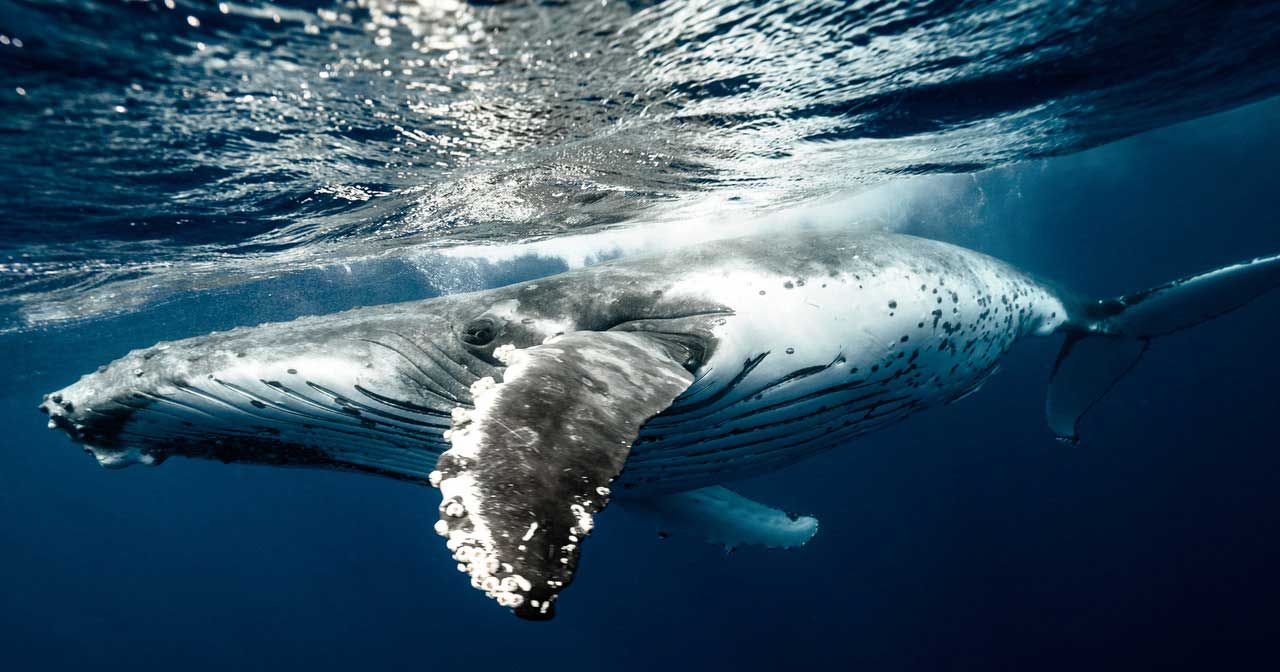
Whales have always aroused genuine interest in people, which is not surprising. These majestic giants surpass almost all dinosaurs in size, and among modern animals they have no equal. Who is the biggest of them all? Introducing the TOP 10 largest whales in the world.
What Types Of Whales Are The Largest On Earth
Humpback whale
Inhabitant of all oceans, except for the Arctic, and the seas adjacent to them, belongs to the minke family. Its body length is on average 14.5 m, and its weight reaches 30 tons. In rare cases, there are 18-meter individuals, respectively, and their weight approaches 35-36 tons. Distinctive features of the appearance of these whales are warty skin growths, located on the snout and pectoral fins, and an unusual dorsal fin resembling a hump. In addition, they have a special coloration that helps distinguish one individual from another. The humpback feeds on crustaceans, fish and molluscs. He is famous for his habit of vigorously jumping out of the water in an upright position, the meaning of which scientists have not yet figured out.
Seiwal
A rare whale of the family of striped whales, it is considered an endangered species. it can reach up to 18m, and in rare cases, up to 20 meters. Its weight reaches 30 tons. It lives in all oceans, avoiding very cold waters of the Antarctic and Arctic, as well as too warm tropical zones. It tries to stay alone or in a couple, in places where food accumulates, it can adjoin herds of several dozen individuals. Black-eyed crustaceans form the basis of the diet of whales common in the southern hemisphere. Representatives of northern latitudes eat fish, crustaceans and molluscs.
Gray whale
Whales with a characteristic grayish-brown color are common in the cold, temperate and subtropical waters of the Pacific Ocean. They prefer coastal areas and can keep in shallow waters. Here they feed on bottom organisms, scooping them up with a huge mouth along with silt and pebbles and then filtering them through a whalebone. The maximum body length of these power-law giants is 15 m, and the mass does not exceed 35 tons. Gray whales are the leaders among mammals in travelling long distances during seasonal migration, they can swim a distance of 19 thousand km per year.
Sperm whale
The largest representative of the suborder of toothed whales. It grows in length up to 20 m, and the mass can reach 50 tons. The sperm whale shouldn’t be confused with any other whale due to very striking external differences. Its huge head, compressed at the sides and pointed, appears rectangular in profile. It makes up at least a quarter of the total body length. The mouth is at the bottom of the head, with the jaw dropping down 90 degrees. These whales are widespread in all oceans; only icy polar waters avoid. They feed mostly on cephalopods, they also eat fish, but in small quantities.
Southern smooth whale
A member of the family of smooth whales. Inhabits the southern subpolar and temperate waters of the Atlantic, Indian and Pacific oceans. Its body length reaches 18 m, and its weight – up to 80 tons. The color of individuals can vary greatly, there are both light brown and almost black whales. Skin growths on the head help identify animals, the location of which is unique for each specimen. The right whale has a curious and outgoing character, for which it previously often became relatively easy prey for whalers. After 1937, hunting for this species of whale was prohibited.
Northern smooth whale
It belongs to the same family as the southern right whale, and is very similar in size and appearance. The body length reaches 18 m and weighs about 80 tons. Its habitat is the northern latitudes of the Atlantic Ocean. It feeds on crustaceans and fish, filtering them through a whalebone. Whales of this species usually stay near feeding places, in the coastal zone, which became the reason for their mass extermination. Up to date, the number of northern smooth whales is about 300-450 individuals. Despite the fact that hunting for these whales has been completely banned, the population is practically not recovering. Each year, researchers record more deaths of northern giants than births of babies.
Japanese whale
Another representative of the family of smooth whales, it differs from the southern and northern relatives in larger sizes: body length can reach 18.5 m, weight – up to 80 kg. It lives in the North Pacific Ocean and gives birth to young off the coast of Japan. Like other smooth whales, the Japanese whale has been heavily hunted, bringing the species to the brink of extinction. At the moment, there are about 500 individuals left in the world. The recovery of the population is proceeding at an extremely low rate, since females are ready for reproduction only at the age of 6 to 12 years and give birth at the same time only 1 baby every 3-4 years.
Fin whale
Refers to minke whales. Distributed in all oceans, does not even avoid the waters of the Arctic and Antarctic. Stays away from coastal areas, does not migrate from the southern hemisphere to the northern or vice versa. For this reason, some scientists distinguish 2 subspecies of these whales: northern and southern. Inhabitants of northern latitudes are usually smaller, their maximum length is 24 m. Southern representatives of fin whales grow up to 27 m, while their weight can approach 70 tons. Planktonic crustaceans form the basis of the diet of these whales, less often fish. Like many other cetacean species, fin whales are endangered. In most countries of the world, hunting them is prohibited.
Bowhead whale
The largest of the family of smooth whales, the only representative of the genus Balaena, has chosen the polar regions of the Northern Hemisphere. He tries not to be directly among the ice, but when this does happen, he makes his way, splitting ice floes up to 22 cm thick. The body length of female whales of this species reaches 22 m, and the mass is 150 tons. Due to such an impressive size, they swim very slowly, at a speed of about 20 km / h. This slowness made the whales easy prey for whalers, since they could catch up with the giant even on an ordinary rowboat. Now hunting bowhead whales is prohibited. According to scientists, there are about 10,000 individuals in the modern population.
Blue whale
The largest whale and he is also the largest representative of mammals. The record length of its body is 33 m, and its weight reaches 150 tons and more. It reaches this size by feeding on plankton and small fish. It lives in the waters of all oceans, but is quite rare. Due to the mass extermination in the early twentieth century, the number of blue whales has declined significantly. According to the latest data, there are no more than 10,000 of them left. Hunting for them is prohibited, but pollution of the seas and other anthropogenic factors pose a serious threat to the modern population.
Sources & References
For further reading, here are the trusted sources we relied on while preparing this article:
Related Reading
Continue exploring with these hand-picked articles from Viral Stories:
- Incredible Animals That Shock the World 2026: 12 Stories That Changed Wildlife Science
- 10 Most Dangerous Animals and their Deadly Destinations
- 10 Amazing Animal Survival Skills You Need to Know
- 5 Animals You Didn’t Know Existed and Their Fascinating Stories
Understanding the Giants: Blue Whales and Beyond
When discussing “What Types Whales Are The” largest on Earth, the blue whale (Balaenoptera musculus) inevitably tops the list. These magnificent creatures can grow up to 100 feet (30 meters) in length and weigh as much as 200 tons. To put this into perspective, their heart alone can weigh as much as an automobile, and their tongue can weigh as much as an elephant. Blue whales are not only the largest whales but also the largest animals to have ever existed on our planet, surpassing even the largest dinosaurs in size.
Despite their massive size, blue whales primarily feed on tiny shrimp-like animals called krill. An adult blue whale can consume up to 4 tons of krill per day during the feeding season. This dietary preference is one of the fascinating aspects of “What Types Whales Are The” most intriguing to researchers. The blue whale’s baleen plates, which can be up to 3 feet long, allow them to filter these small organisms from the water efficiently.
Another notable giant in the world of whales is the fin whale (Balaenoptera physalus), often referred to as the “greyhound of the sea” due to its slender body and impressive speed. Fin whales can reach lengths of up to 85 feet (26 meters) and are known for their incredible migratory patterns, traveling thousands of miles each year. While not as massive as the blue whale, the fin whale is still one of the largest species and is known for its distinctive ridge behind the dorsal fin, which is a key identifier for researchers.
Conservation Efforts and the Role of “What Types Whales Are The” in the Ecosystem
Understanding “What Types Whales Are The” largest is not just about appreciating their size and beauty; it’s also about recognizing their importance in the marine ecosystem. Whales, particularly the larger species, play a significant role in maintaining the health of the oceans. Their excrement, rich in iron and nitrogen, fertilizes the ocean waters, promoting the growth of phytoplankton. These microscopic organisms are not only the base of the marine food chain but also crucial in absorbing carbon dioxide from the atmosphere, thus helping to regulate the Earth’s climate.
Unfortunately, many of these majestic creatures face numerous threats, including habitat loss, pollution, and climate change. Overfishing and collisions with ships are also significant concerns. Conservation efforts are critical to ensure the survival of “What Types Whales Are The” most at risk. International agreements like the International Whaling Commission (IWC) have been established to regulate whaling and protect whale populations. Additionally, marine protected areas (MPAs) have been designated in various parts of the world to provide safe havens for these gentle giants.
Experts suggest several actionable tips to support whale conservation:
- Support Marine Conservation Organizations: Donate to or volunteer with organizations dedicated to marine life conservation.
- Reduce Plastic Use: Minimize the use of single-use plastics to reduce ocean pollution.
- Advocate for Sustainable Fishing Practices: Support policies and practices that promote sustainable fishing and protect marine habitats.
- Educate Others: Spread awareness about the importance of whales and the threats they face.
The Cultural and Scientific Significance of “What Types Whales Are The”
Whales have long held a special place in human culture and mythology. Indigenous peoples around the world have revered whales, often featuring them in their art, stories, and spiritual practices. The cultural significance of “What Types Whales Are The” most revered varies across different societies, but they are universally seen as symbols of strength, wisdom, and freedom.
From a scientific perspective, studying whales provides valuable insights into the evolution of mammals and the adaptations that allow such large creatures to thrive in marine environments. Researchers are particularly interested in the social structures and communication methods of whales. For instance, the complex songs of humpback whales have been studied extensively, revealing intricate patterns and structures that suggest a sophisticated level of communication.
Moreover, the study of “What Types Whales Are The” largest can also inform our understanding of climate change and its impacts on marine life. Changes in whale migration patterns and feeding habits can serve as indicators of shifts in ocean temperatures and currents, providing early warnings of broader ecological changes.
In conclusion, understanding “What Types Whales Are The” largest is not just about recognizing their physical attributes but also about appreciating their ecological, cultural, and scientific importance. By deepening our knowledge and taking action to protect these magnificent creatures, we can help ensure that they continue to thrive for generations to come.
Visual Guide
Frequently Asked Questions
What is this topic and why does it matter?
This depends on your specific situation, but the section on what types of whales are the largest on earth covers the details. Most readers find that following a consistent approach with this topic delivers the best results. Read on for evidence-based guidance and step-by-step methods you can apply today.
How does this topic work in practice?
Getting started with this topic is simpler than most people think. The key is following proven strategies consistently. This guide walks you through each step with practical examples and expert recommendations for lasting success.
What are the main benefits of this topic?
Getting started with this topic is simpler than most people think. The key is following proven strategies consistently. This guide walks you through each step with practical examples and expert recommendations for lasting success.
How long does it take to see results from this topic?
Getting started with this topic is simpler than most people think. The key is following proven strategies consistently. This guide walks you through each step with practical examples and expert recommendations for lasting success.
What are common mistakes to avoid with this topic?
Getting started with this topic is simpler than most people think. The key is following proven strategies consistently. This guide walks you through each step with practical examples and expert recommendations for lasting success.
“`htmlIdentifying the Largest Whale Species on Earth
When discussing “What Types Whales Largest Earth,” it’s essential to understand the characteristics that make these creatures the largest. The blue whale, for instance, is not only the largest whale but also the largest animal to have ever existed on Earth. Its immense size, reaching up to 100 feet in length, is a testament to the incredible diversity of life in our oceans. By focusing on “What Types Whales Largest Earth,” we can appreciate the evolutionary marvels that have allowed these giants to thrive in marine environments.
Another significant species in the discussion of “What Types Whales Largest Earth” is the fin whale. Known for its sleek body and impressive speed, the fin whale is the second largest whale species. Its size and migratory patterns highlight the adaptability and resilience of these creatures. By examining “What Types Whales Largest Earth,” we gain insights into the ecological roles these whales play and the importance of their conservation.
Conservation Efforts for the Largest Whale Species on Earth
Understanding “What Types Whales Largest Earth” is not just about recognizing their sizes but also about acknowledging the challenges they face. Human activities, such as shipping, fishing, and climate change, pose significant threats to these magnificent creatures. To ensure the survival of the largest whale species on Earth, conservation efforts must be intensified. Here are some actionable tips:
- Support Marine Protected Areas: Advocate for the creation and maintenance of marine protected areas that safeguard the habitats of the largest whale species on Earth.
- Reduce Ocean Pollution: Minimize the use of plastics and other pollutants that endanger the lives of whales and other marine life.
- Promote Sustainable Fishing: Encourage practices that prevent accidental entanglements and ensure the sustainability of fish populations that whales depend on.
- Educate and Raise Awareness: Share knowledge about “What Types Whales Largest Earth” to inspire others to take action and contribute to conservation efforts.
By focusing on “What Types Whales Largest Earth,” we can better understand the importance of these creatures in maintaining the health of our oceans. Their large size and presence play a vital role in the marine ecosystem, and their conservation is essential for the balance of ocean life. As we continue to explore the topic of “What Types Whales Largest Earth,” we must remain committed to protecting these majestic beings for future generations.
In summary, the exploration of “What Types Whales Largest Earth” reveals the awe-inspiring diversity and grandeur of the largest whale species. By implementing the tips above and supporting conservation initiatives, we can help ensure that these magnificent creatures continue to thrive in the world’s oceans. The journey to understand “What Types Whales Largest