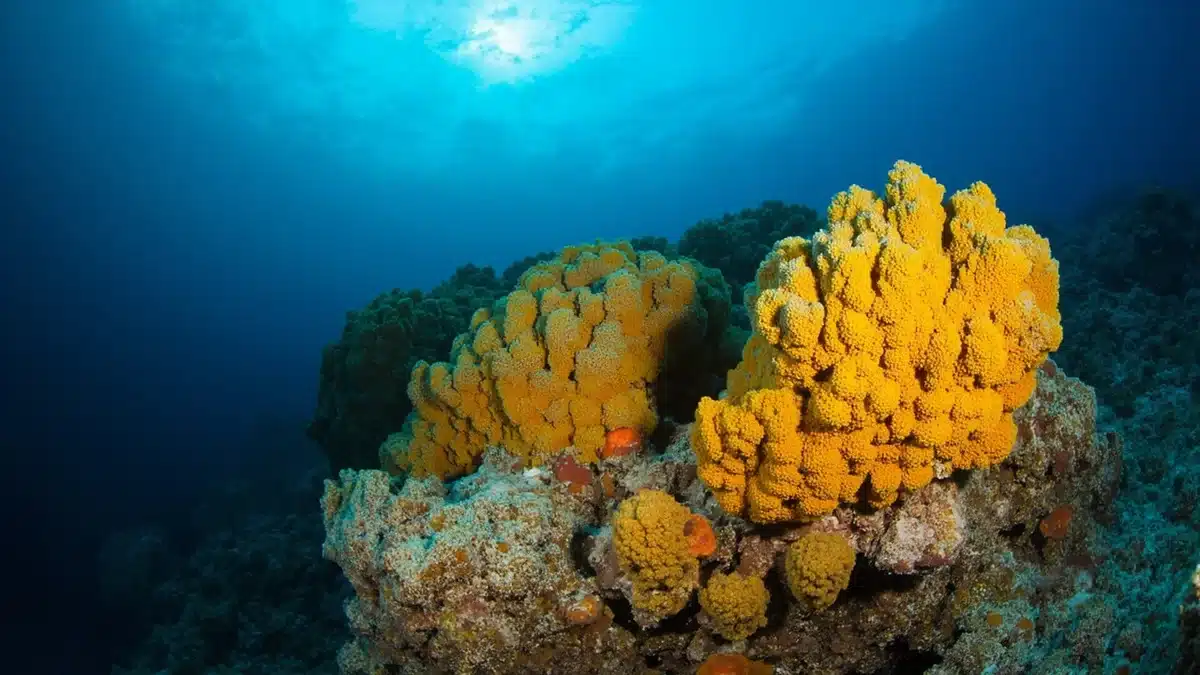
A team of marine scientists returned from two weeks off the coast of Brazil in early 2026 carrying a haul that would have taken a generation to confirm using older methods: thirty-one deep sea creatures 2026 that nobody had ever formally identified before. The expedition, run by Schmidt Ocean Institute aboard the research vessel Falkor (too), turned what used to be a slow, decades-long process of describing strange ocean animals into something closer to a fortnight of fieldwork. And those were just the species on one ship. Weeks earlier, a parallel voyage along the Argentine shelf turned up twenty-eight more suspected newcomers, including a coral reef the size of Vatican City. Together, these voyages are starting to answer one of the strangest gaps in modern biology: how little we know about the largest habitat on Earth.
Table of Contents
- The Brazil Expedition: 31 New Deep Sea Creatures in Two Weeks
- Why Midwater Is Earth’s Largest Habitat
- Standout Deep Sea Creatures 2026 Caught on Camera
- Argentina’s Surprise: A Coral Reef the Size of Vatican City
- How Scientists Identify New Species So Quickly
- What These Finds Mean for the Rest of the Ocean
- Frequently Asked Questions
The Brazil Expedition: 31 New Deep Sea Creatures 2026 in Two Weeks
The ship left Fortaleza in the northeast of Brazil with a small international team of midwater specialists. They were not going down to the seafloor on this trip. Their target was the layer of water between the sunlit surface and the bottom, the band oceanographers call the midwater. It is, by volume, the largest animal habitat on Earth, and yet most of the species that live there have never been seen alive by a human. The scientists on board used the remotely operated vehicle SuBastian, run by Schmidt Ocean Institute, to drop slowly through the column and record what they met. The deep sea creatures 2026 record grew faster on this single cruise than during the entire previous decade of midwater surveys combined.
By the end of the cruise, the team had confirmed thirty-one new species, including an amphipod, a gossamer worm from the genus Tomopteris that swam faster than its body shape seemed to allow, nine jellyfish, seven siphonophores, seven comb jellies, four larvaceans, and two single-celled giants called rhizarians. Each of those categories contains dozens of known species, and the expedition added brand new members to every one. Dr. Karen Osborn of the Smithsonian National Museum of Natural History, who served as chief scientist, summed up the mood in a single sentence: the largest habitat on Earth, the midwater, is filled with incredible animals we are only just starting to understand.
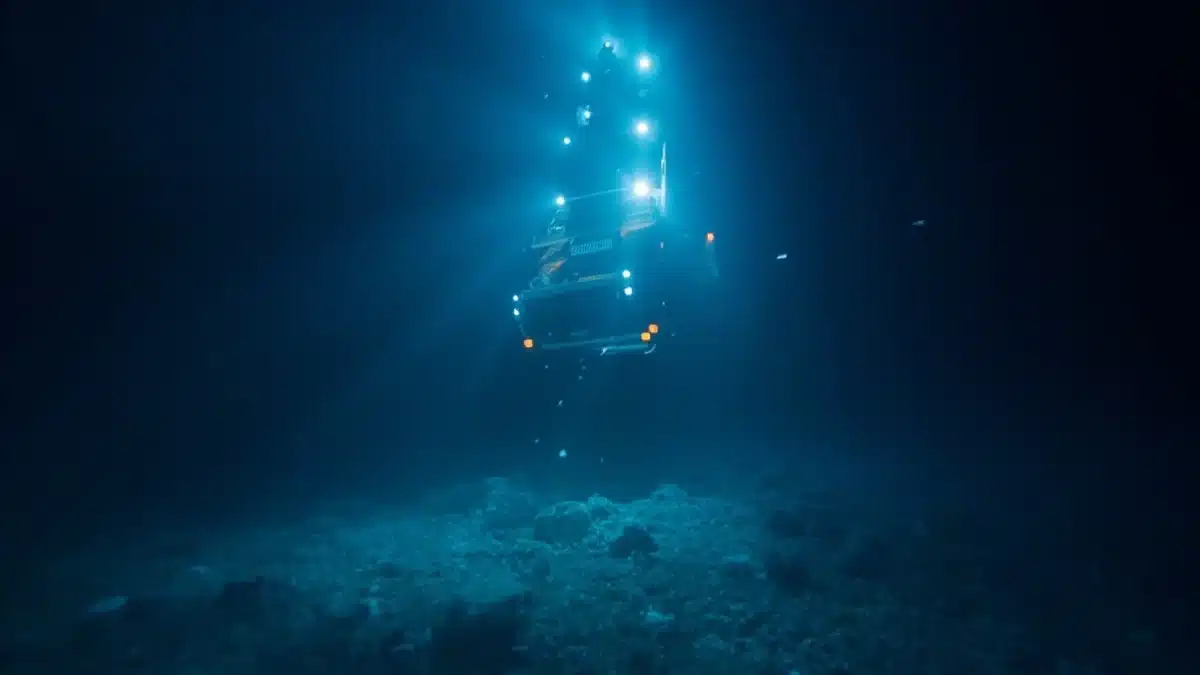
What makes the number matter is the speed. A century ago, identifying a new deep sea creature meant hauling it to the surface in bad condition, sending it to a museum, and waiting for a specialist with the right taxonomic keys to publish a paper. That process often took twenty or thirty years from the moment of first capture to the formal description. The 2026 Brazil team described new species in days, because every specimen was photographed at depth in high resolution and sequenced on board using portable genomic kits. The combination of a clear image and a clean DNA barcode is enough to mark an animal as new without having to compare it, bone by bone, to every specimen stored in a museum drawer.
The list of confirmed deep sea creatures 2026 from this cruise is also unusually broad. Most expeditions return with one or two new amphipods, or one or two new jellies. This trip added new species across nearly every major midwater group. That breadth is a sign that midwater diversity is not a curiosity limited to one corner of the ocean. It is a global pattern hiding in plain sight. The deep sea creatures 2026 haul from Brazil is now the single largest confirmed-species list from a single midwater cruise in the past decade.
Why Midwater Is the Largest Habitat for Deep Sea Creatures 2026
Walk to the nearest coast and look out at the sea. The dark blue water you see is the top of the midwater. Below the surface, light fades quickly. By a few hundred meters down, the world is permanently dim. Below a thousand meters, it is essentially black. The water column between the sunlit zone and the seafloor spans roughly four kilometers of vertical space on average, and it covers almost the entire planet. Nothing else on Earth comes close to that volume.
Almost no sunlight reaches this layer, so most of the animals here do not see. Many make their own light through a chemical reaction called bioluminescence. A passing predator looks like a slow-moving constellation of blue and green flashes. Prey animals use the same trick to confuse attackers, attract mates, or lure prey of their own. The midwater is, in a real sense, a dark planet wrapped around the one we live on, full of creatures we have only started to catalogue.
Estimates of how many species live there are blunt. Scientists who work in the field put the number in the high tens of thousands, possibly more than a hundred thousand. Of those, only a fraction have been formally named. Every focused cruise, including the 2026 Brazil trip, has so far added new species faster than researchers can publish them. The race is not whether there are more species; it is whether we can describe them in time to protect them. For deep sea creatures 2026 specifically, the count grows by dozens every quarter.
Standout Deep Sea Creatures 2026 Caught on Camera
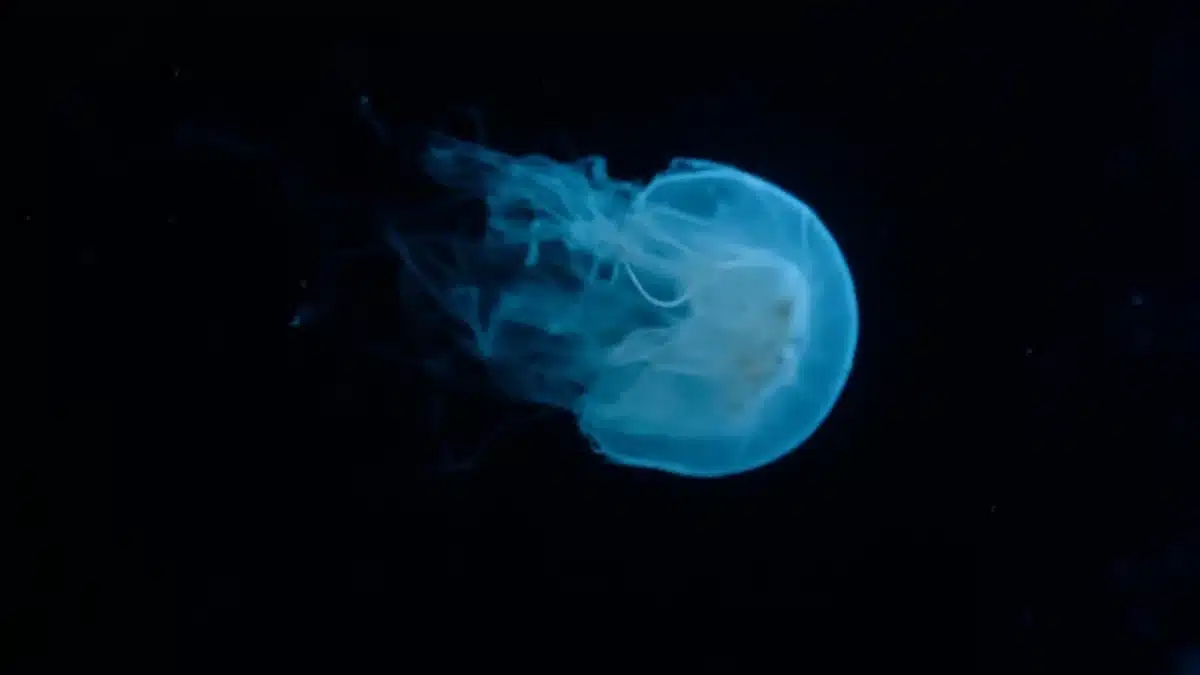
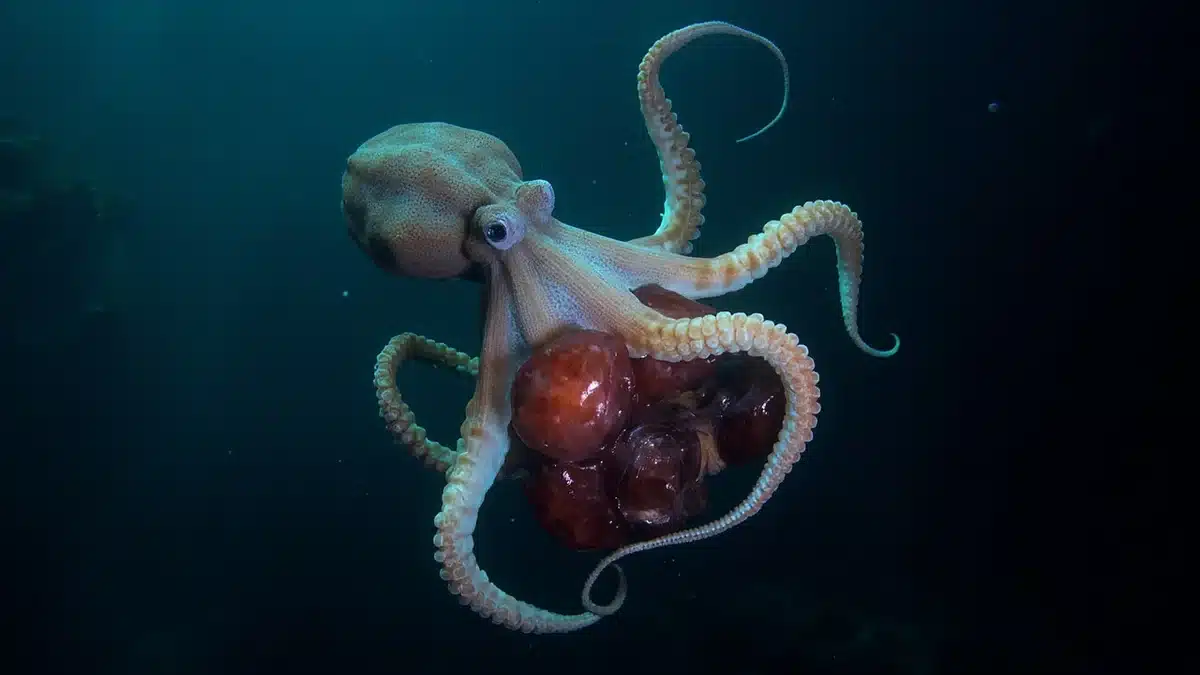
The 2026 deep sea creatures haul included a few animals that read like science fiction. A female Haliphron atlanticus, a pelagic octopus that can weigh more than a person, was filmed at around 800 meters depth eating a bright red jellyfish. The ROV footage caught the moment of capture in clear detail. Predation events at this depth are extraordinarily rare on camera, because the animals involved are transparent or fragile, and the lights of an ROV often scare them off. In this case the octopus held on.
The Tomopteris gossamer worm surprised the team with how fast it could swim. Most species in this genus drift through the water column, beating small paddles along their sides. The new species beat them faster than the body shape seemed to predict. Its muscle layout does not match the textbook image of a slow, drifting worm, and that mismatch is part of what makes it a new species rather than another colour variation of a known one.
The four larvaceans from the Brazil trip are also worth a closer look. Larvaceans are tadpole-shaped animals that build mucus houses around themselves. The houses filter passing food particles, and when they clog, the animal simply abandons the structure and builds a new one. The discarded houses sink toward the seafloor and form a large share of the carbon that reaches the deep ocean each year. Larvaceans are chordates, which puts them in the same broad group as humans, even though no one would guess it from looking at one.
On the Argentine shelf, scientists documented a phantom jellyfish of the genus Stygiomedusa. The species was first described in 1910, and fewer than 130 confirmed sightings have been recorded since. Its bell can grow to more than a meter across, and it trails four ribbon-like arms that can stretch six meters or more. Seeing one in its native habitat, instead of tangled in a fishing net, is the kind of moment that justifies an entire expedition. Deep sea creatures 2026 includes a small number of these legacy sightings, captured on camera for only the second or third time.
Argentina’s Surprise: A Coral Reef the Size of Vatican City
The Argentine cruise was supposed to map continental shelf life from Buenos Aires down to Tierra del Fuego. The team, led by Dr. María Emilia Bravo of the University of Buenos Aires and CONICET, did not expect to find a brand new coral reef. They found one anyway. The reef is built around a deep-sea coral called Bathelia candida, and it covers at least 0.4 square kilometers, which works out to roughly the size of Vatican City. It is now the largest known reef of this species anywhere in the global ocean. The find is one of the most consequential deep sea creatures 2026 records from any South Atlantic cruise.
Cold-water corals are slow. A Bathelia candida colony may live for centuries or longer, building its skeleton at a rate of less than a millimeter per year. Reefs of this kind are classified as Vulnerable Marine Ecosystems because they support unusually high biodiversity and they are easily broken by bottom trawling. The discovery of a new reef of this scale, in 2026, in a heavily studied part of the South Atlantic, is a reminder of how incomplete the maps of the deep ocean really are.
The Argentine team also documented several chemically rich cold seeps, communities of animals that live off hydrogen sulfide and methane leaking from the seafloor rather than sunlight. These systems support tubeworms, mussels, and specialized bacteria that turn toxic gas into food. The new reef and the seeps sit close enough together that scientists can now study how the two ecosystems interact, which has not been possible before at this resolution.
How Scientists Identify New Species So Quickly
The reason the 2026 numbers look so much higher than older cruises is not that the ocean suddenly got more species. It is that the tools changed. Three advances, layered together, are doing the heavy lifting.
The first is high-resolution imaging at depth. ROVs like SuBastian carry 4K cameras that record animals in their natural posture and colour, before the stress of capture changes them. A jellyfish that looked like a featureless blob on a deck at 2 a.m. can now be matched to a clear reference image.
The second is environmental DNA, often shortened to eDNA. A sample of seawater carries traces of skin, mucus, eggs, and waste from every animal that passed through that patch of water in the last few days. Sequencing that sample tells scientists which species were present, even ones they never saw. NOAA Ocean Exploration released a deep-sea environmental DNA dataset in 2026 that has begun to fill in the gaps between sparse visual surveys.
The third is portable genomic sequencing on board the research vessel itself. The team on the Brazil cruise took a small specimen, extracted its DNA, and ran a barcode comparison within hours. If the barcode did not match any known sequence, the animal was provisionally tagged as a new species. Confirmation by a taxonomist at a museum can still take months, but the identification work happens on the ship. The role of MBARI in providing the imaging and AUV technology for these cruises has been central.
None of this replaces the careful eye of a specialist. What it does is shrink the time from “we saw something strange” to “we know it is new” by an order of magnitude. That matters because the ocean is changing faster than the old pace of science could keep up. For deep sea creatures 2026 the gain is not just speed but also consistency across oceans.
What These Finds Mean for the Rest of the Ocean
Discovering thirty-one new deep sea creatures in two weeks sounds like a feel-good story, and most of it is. But the same tools that reveal new species also reveal how much we stand to lose. The hydrothermal vents found in the Doldrums Fracture Zone in 2026, mixed volcanic and serpentinization systems, sit in international waters where several countries are pushing to allow deep-sea mining for cobalt, nickel, and rare earth elements. A mining operation would strip the seafloor for tens of kilometers around each vent. The animals that live only at those vents would disappear before most of them had a scientific name. Deep sea creatures 2026 sits at the front line of that debate.
The new coral reef on the Argentine shelf sits in national waters, which gives the Argentine government clearer tools to protect it. The expedition team has already shared the reef coordinates with national park managers and is helping to draft a management plan. Whether that plan will be in place before any trawler notices the location is a separate question.
For the broader public, the lesson of the 2026 deep sea creatures haul is not that the ocean is full of monsters. It is that the ocean is full of ordinary, fragile animals doing ordinary things in a habitat we have barely looked at. Knowing what is down there is the first step toward keeping it there. The Schmidt Ocean Institute, MBARI, NOAA Ocean Exploration, and partner universities have started to map that space in real time. The next decade will be defined by whether governments match the pace of discovery with the pace of protection.
Frequently Asked Questions About Deep Sea Creatures 2026
How many new deep sea creatures 2026 expeditions actually discover?
The 2026 Brazil expedition alone confirmed 31 new species in roughly two weeks. The Argentine expedition along the same coast added 28 more suspected species. In both cases, only a fraction of the suspected species have been formally published. The total for 2026 across all ocean basins is in the low hundreds, and the rate is climbing each year as more ships deploy the same imaging plus DNA workflow. A single focused cruise can now return with more confirmed deep sea creatures 2026 than an entire decade of midwater surveys produced in the 1990s.
Why are so many deep sea creatures 2026 still unknown to science?
The midwater between the sunlit zone and the seafloor is the largest habitat on Earth by volume, and it is the hardest to sample. Until recently, deep sea creatures 2026 could only be studied by lowering nets on long cables, which damages fragile animals and misses fast swimmers. New ROVs, AUVs, and environmental DNA tools are starting to close that gap, but the backlog of undescribed species from past decades is still enormous. The deep sea creatures 2026 record is essentially a snapshot of one research season, not a final tally.
What is the deepest place where new deep sea creatures 2026 have been found?
Most of the 2026 deep sea creatures 2026 finds came from midwater depths between roughly 200 and 1500 meters, where the Schmidt Ocean Institute expeditions operated. Deeper finds, including hadal species from trenches below 6000 meters, are documented separately and require different sampling gear. The 2026 haul is concentrated in midwater because that is where the imaging and eDNA tools work best right now. Hadal-zone deep sea creatures 2026 work is scheduled for late 2026 and 2027 using a new generation of full-ocean-depth landers.
Can anyone see images from these deep sea creatures 2026 expeditions?
Yes. Schmidt Ocean Institute posts high-resolution ROV video from every expedition on its YouTube channel and on its website at schmidtocean.org. MBARI maintains the Deep-Sea Guide at mbari.org, an interactive database of midwater observations. NOAA Ocean Exploration hosts the NOAA Ocean Exploration Digital Atlas, which includes video, stills, and environmental DNA reads from federal expeditions. Most of the imagery from the 2026 Brazil and Argentina cruises is already public. Educators are already weaving deep sea creatures 2026 footage into K-12 ocean science modules.
Are deep sea creatures 2026 threatened by climate change or deep-sea mining?
Both. Midwater animals are sensitive to warming, deoxygenation, and acidification at the surface, which propagate downward over decades. Hydrothermal vent communities are also directly threatened by deep-sea mining proposals for cobalt, nickel, and rare earth elements. The Doldrums Fracture Zone vents found in 2026 sit in international waters where mining rules are still being negotiated. Coral reefs on the Argentine shelf are threatened by bottom trawling unless they are protected under domestic marine park rules. Deep sea creatures 2026 sit at the center of both debates.
How can a species be confirmed as new in days instead of decades?
The fast confirmation comes from pairing a clean photograph with a DNA barcode. If the genetic sequence does not match any sequence in the public databases, the animal is provisionally new. A taxonomist still has to publish the formal description, but the heavy lifting of separating the species from its relatives is done at sea. That is why the deep sea creatures 2026 numbers are higher than for any previous year.
Where can I read the original scientific papers on deep sea creatures 2026?
The Schmidt Ocean Institute posts cruise reports at schmidtocean.org/news and links to peer-reviewed papers in Zootaxa, Marine Biodiversity Records, and other journals as they publish. MBARI maintains a publications page at mbari.org/publications. For raw environmental DNA datasets, NOAA Ocean Exploration hosts the deep-sea eDNA dataset at oceanexplorer.noaa.gov.
Conclusion
The deep sea creatures 2026 haul is a snapshot of a single moment in a much longer scientific story. The animals themselves have lived in the midwater for millions of years. What changed in 2026 is the speed at which humans can find them and put a name on them. The next round of cruises will likely double the count again. The harder question, the one that will outlast any single expedition, is what we choose to do with that knowledge once we have it. The deep sea creatures 2026 record will keep growing. The protection of the habitats that hold them has to grow at the same pace.
ViralUntold
Editor at ViralUntold. Filing dispatches on the stories behind the headlines.


More from Animals
Other stories in the Animals beat, filed continuously by the ViralUntold desk.