


Diamonds Raining on Neptune and Other Fascinating Planetary Mysteries
Estimated reading time: 8 minutes
Table of Contents
Key Takeaways
- Diamonds on Neptune result from extreme pressure and temperature conditions.
- The “Face on Mars” is an optical illusion caused by Martian geological formations.
- Recent studies indicate that Venus may erupt volcanic-ally again.
- Saturn’s hexagonal storm is a mysterious atmospheric phenomenon that continues to intrigue scientists.
- Water reservoirs found on the Moon have crucial implications for future space missions.
Table of contents
Diamonds Raining on Neptune
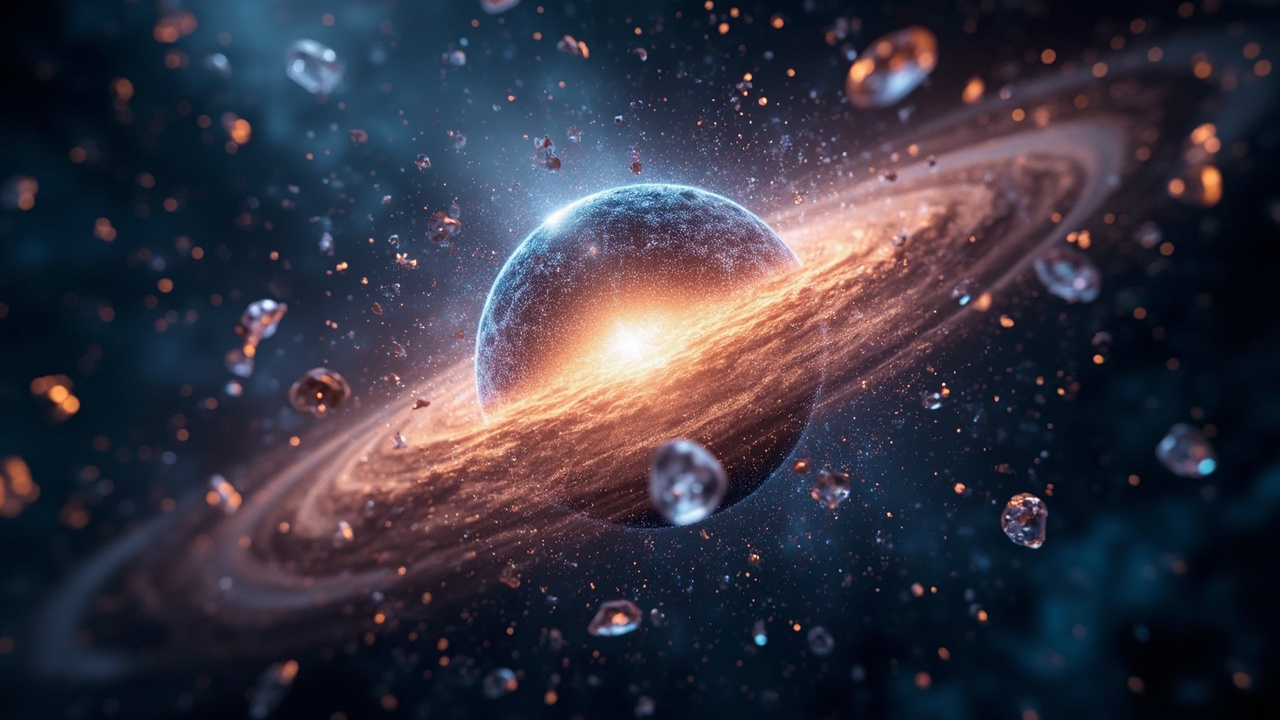
Among the many awe-inspiring discoveries about our solar system, the notion that “diamonds are raining on Neptune” is one that both excites and mystifies scientists and enthusiasts alike. Neptune, the eighth planet from the Sun, has been a subject of extensive study due to its extreme conditions, which may allow such remarkable phenomena to occur.
Neptune’s atmosphere is predominantly composed of hydrogen, helium, and methane, but it is the immense pressure and frigid temperatures that create an environment conducive for diamonds.
- High Pressure and Temperature: The conditions in Neptune’s atmosphere reach astonishing levels, with pressures exceeding 7 million times that of Earth’s atmosphere, leading to the formation of the crystalline structures we recognize as diamonds.
- Laboratory Simulations: Research conducted by NASA has successfully replicated these extreme conditions through laboratory simulations. These experiments show how carbon, under such intense pressure, can crystallize and potentially result in diamond formation. (Source: NASA)
Mars’ Face-Shaped Mountain Myth
The enigmatic “Face on Mars,” first captured in a photograph by the Viking 1 spacecraft in 1976, sparked intense debate and speculation about extraterrestrial life and intelligence. It has since become a cornerstone in the lore of our explorations of Mars.
However, what many believed was an artificial structure is actually a result of natural geological processes.
- Geological Features: Erosion combined with the way sunlight interacts with the surface of Mars created the illusion of a face-like formation. This effect was further enhanced by varying angles of lighting conditions across different imagery.
- Popular Culture Impact: This phenomenon has not only fascinated scientists but also captured the imagination of the public and media, influencing various films and literature that explore themes of life on Mars.
Venus’ Volcanic Apocalypse
Venus, often referred to as Earth’s twin due to its similar size and proximity, presents an entirely different narrative when it comes to its geological activity and atmosphere.
The planet’s dense atmosphere is rich in carbon dioxide and is dominated by intense heat, resulting in a surface temperature hot enough to melt lead. Recent studies by the European Space Agency (ESA) suggest that volcanic activity on Venus may still be a very real phenomenon.
- Volcanic Activity: ESA’s observations have indicated evidence suggesting that some of the planet’s volcanic activity may have occurred as recently as a few million years ago. This finding raises significant questions regarding the planet’s geological volatility.
- Hostile Environment: The combination of high-pressure weather patterns and volcanic activity contributes to the extreme conditions that challenge any exploration efforts. (Source: ESA)
Saturn’s Hexagon Storm Mystery
Saturn’s north pole is home to a perplexing and intriguing hexagonal storm pattern that measures about 32,000 kilometers across. This storm, unlike any other observed in our solar system, has sparked a multitude of scientific inquiries into its structure and behavior.
The observation of this unusual phenomenon is credited to the Cassini spacecraft, which provided detailed images and measurements during its mission.
- Weather Patterns: The hexagon’s persistent and stable shape is a striking feature of Saturn’s atmospheric patterns, leading scientists to theorize that it may be influenced by the planet’s rotational dynamics.
- Cassini Spacecraft: The insights gathered by Cassini have significantly enhanced our understanding of Saturn’s atmospheric dynamics and weather. The hexagon also exhibits a rotating storm at each of its corners, which is an intriguing aspect for ongoing research. (Source: NASA Cassini)
Moon’s Hidden Water Reservoirs
The discovery of water on the Moon has transformed our understanding of lunar geology and its potential for future exploration and habitation. NASA’s Lunar Reconnaissance Orbiter has identified significant ice deposits located at the lunar poles.
This revelation has profound implications for future human missions to the Moon and beyond.
- Lunar Base Potential: Water is essential for sustaining human life, making the Moon an attractive target for establishing a permanent base.
- Exploration Impact: These findings are instrumental in planning and supporting missions aimed at Mars and beyond. The availability of water can significantly affect mission logistics and longer-term stays on other celestial bodies. (Source: NASA Moon)
Conclusion
The exploration of planetary mysteries not only highlights the wonders of our solar system but also fuels the thirst for knowledge that defines humanity. From the possibility of diamonds raining on Neptune to the extraordinary geological hints on Mars, and the volcanic landscapes of Venus, each discovery enriches our cosmic understanding.
Embracing these scientific inquiries empowers us to push the boundaries of what we know and opens new avenues for exploration. The call to further investigate these enigmas will undoubtedly continue to inspire generations of scientists, engineers, and explorers.
Call to Action
If you want to stay connected with the latest discoveries in space and planetary sciences, be sure to subscribe to our blog. Get insights and exciting updates right to your inbox, so you never miss a moment of exploration!
- Subscribe: Join our community for updates on space and planetary science.
- Related Articles: Explore our other writings, such as “Exploring Jupiter’s Moons” and “Life on Mars Potential”.
By continuing to delve into these mysteries, we not only expand our understanding but also fuel the dream of reaching farther into the cosmos.
Related Reading
Continue exploring with these hand-picked articles from Viral Stories:
- Lab Discoveries You Won’t Believe 2026: 7 Mind-Blowing Breakthroughs That Just Happened
- Scientists Found a Surprisingly Simple Way to Create Powerful Quantum States
- 10 Mind-Blowing Facts About Space That Will Astonish You
- 10 Science Facts That Seem Unbelievable and Mind-Blowing
The Science Behind “Diamonds Raining Unveiling Fascinating Planetary” Phenomena
The concept of “Diamonds Raining Unveiling Fascinating Planetary” mysteries might sound like science fiction, but it is deeply rooted in scientific principles. The idea primarily revolves around the atmospheric conditions of planets like Neptune and Uranus, where extreme pressures and temperatures can lead to the formation of diamonds. Scientists believe that the intense heat and pressure thousands of miles below the surfaces of these gas giants can cause carbon atoms to crystallize, forming diamonds that then rain down through the planet’s atmosphere.
Research conducted by the University of California, Berkeley, suggests that the process begins with methane, which is abundant in the atmospheres of these planets. When methane is subjected to high pressures and temperatures, it breaks down into hydrogen and carbon. The carbon atoms then bond together in a crystalline structure, forming diamonds. These diamonds are thought to be much larger than those found on Earth, potentially weighing millions of carats.
Experts in planetary science, like Dr. Kevin Baines from the University of Wisconsin-Madison, have further theorized that these diamond showers could be a common occurrence on ice giants. The diamonds might eventually sink into the planet’s core, creating a thick layer of diamond material. This phenomenon is not just limited to Neptune and Uranus; it could also occur in exoplanets with similar atmospheric conditions.
Understanding the science behind “Diamonds Raining Unveiling Fascinating Planetary” phenomena can provide insights into the composition and behavior of these distant worlds. It also opens up possibilities for future space missions aimed at studying these planets in more detail.
Practical Tips for Stargazers: Observing “Diamonds Raining Unveiling Fascinating Planetary” Events
For those fascinated by the idea of “Diamonds Raining Unveiling Fascinating Planetary” events, there are several ways to engage with this intriguing topic. While you won’t be able to see the actual diamond rain from Earth, you can still observe the planets where this phenomenon is believed to occur. Here are some practical tips for stargazers:
- Use a Quality Telescope: To get a good view of Neptune and Uranus, invest in a high-quality telescope. Look for one with a large aperture and high magnification capabilities.
- Join an Astronomy Club: Astronomy clubs often have access to more powerful telescopes and can provide guided tours of the night sky. This is a great way to learn more about the planets and their unique features.
- Attend Star Parties: Many observatories and science centers host star parties where you can observe planets and other celestial objects. These events often include lectures and discussions about the latest discoveries in planetary science.
- Follow Space Missions: Keep an eye on space missions that aim to study ice giants. NASA’s upcoming Uranus Orbiter and Probe mission, for example, could provide new insights into the “Diamonds Raining Unveiling Fascinating Planetary” phenomenon.
- Read Scientific Journals: Stay informed about the latest research on diamond rain and other planetary mysteries by reading scientific journals and articles. This will give you a deeper understanding of the processes at work on these distant worlds.
By following these tips, you can enhance your appreciation for the “Diamonds Raining Unveiling Fascinating Planetary” phenomena and gain a better understanding of the universe. Whether you’re a seasoned astronomer or a casual stargazer, there’s always something new to discover in the night sky.
The Future of “Diamonds Raining Unveiling Fascinating Planetary” Research
As our understanding of “Diamonds Raining Unveiling Fascinating Planetary” events continues to grow, so too does the potential for groundbreaking discoveries. Researchers are constantly developing new technologies and methods to study the atmospheres and interiors of planets like Neptune and Uranus. One promising area of research is the use of advanced computer simulations to model the conditions under which diamond rain occurs.
These simulations can help scientists predict the behavior of carbon and other elements under extreme pressures and temperatures. By comparing these predictions with observational data, researchers can refine their models and gain a more accurate picture of the processes at work on these planets. This, in turn, could lead to new insights into the formation and evolution of ice giants and other planetary bodies.
Another exciting development is the potential for future space missions to directly observe “Diamonds Raining Unveiling Fascinating Planetary” phenomena. While current technology limits our ability to send probes to the distant reaches of the solar system, advancements in spacecraft engineering and propulsion could make such missions possible in the coming decades. These missions could provide unprecedented insights into the composition and behavior of ice giants, shedding new light on the “Diamonds Raining Unveiling Fascinating Planetary” mystery.
In the meantime, scientists will continue to study the data collected by telescopes and space probes, searching for clues about the nature of these distant worlds. As our knowledge of the universe expands, so too does our appreciation for the incredible diversity of planetary phenomena, including the tantalizing possibility of diamonds raining down on distant planets.
Visual Guide



Frequently Asked Questions
What causes diamonds to rain on Neptune?
Diamonds rain down on Neptune due to the extreme pressures and temperatures that cause carbon to crystallize into diamond structures.
Is the Face on Mars a sign of extraterrestrial life?
The “Face on Mars” is an optical illusion created by natural terrain and lighting, with no evidence supporting the existence of extraterrestrial life.
What volcanic activity has been confirmed on Venus?
Recent studies suggest that Venus may be volcanic-ally active, with signs of eruptions occurring a few million years ago.
What is the significance of the hexagonal storm on Saturn?
The hexagonal storm is significant as it represents unique atmospheric dynamics, providing insights into Saturn’s weather patterns and atmospheric conditions.
How does the discovery of water on the Moon impact space exploration?
Finding water on the Moon is crucial for future missions as it can support human life and serve as a resource for missions to Mars and beyond.
The Science Behind Diamonds Raining Unveiling Fascinating Planetary Phenomena
Diamonds raining on planets like Uranus and Neptune is not just a fascinating concept but a phenomenon deeply rooted in the science of extreme conditions. Understanding the processes that lead to diamonds raining can provide valuable insights into the composition and behavior of these distant worlds. By studying the high-pressure environments where carbon transforms into diamonds, scientists can unlock new knowledge about the materials and forces at play in the universe.
Actionable Tips for Exploring Diamonds Raining Unveiling Fascinating Planetary Mysteries
For those intrigued by the idea of diamonds raining and wish to explore this topic further, here are some actionable tips:
- Stay Updated: Follow scientific journals and publications that frequently cover discoveries related to diamonds raining unveiling fascinating planetary secrets. This will keep you informed about the latest research and findings.
- Engage with Experts: Participate in forums and discussions where experts share their insights on diamonds raining and other planetary mysteries. Engaging with professionals can provide deeper understanding and answer any questions you might have.
- Utilize Online Resources: Take advantage of online courses and webinars that focus on planetary science. These resources often cover topics like diamonds raining, offering both theoretical knowledge and practical applications.
- Join Astronomy Clubs: Becoming a member of an astronomy club can connect you with like-minded individuals who share an interest in diamonds raining and other cosmic phenomena. This can lead to collaborative projects and shared learning experiences.
- Attend Conferences: If possible, attend conferences and seminars that focus on planetary science. These events often feature presentations and discussions specifically about diamonds raining and other related topics.
Diamonds raining on planets like Uranus and Neptune is a captivating subject that continues to intrigue scientists and enthusiasts alike. By exploring the science behind diamonds raining, we gain a better understanding of the universe’s complexity and the unique conditions that exist on other planets. Whether you’re a seasoned researcher or a curious learner, engaging with the topic of diamonds raining unveiling fascinating planetary mysteries can be both educational and inspiring.
Incorporating these tips into your exploration of diamonds raining can enhance your understanding and appreciation of the subject. As more research is conducted and new discoveries are made, the field of planetary science will continue to evolve, offering even more insights into the phenomenon of diamonds raining and the fascinating worlds where it occurs.